
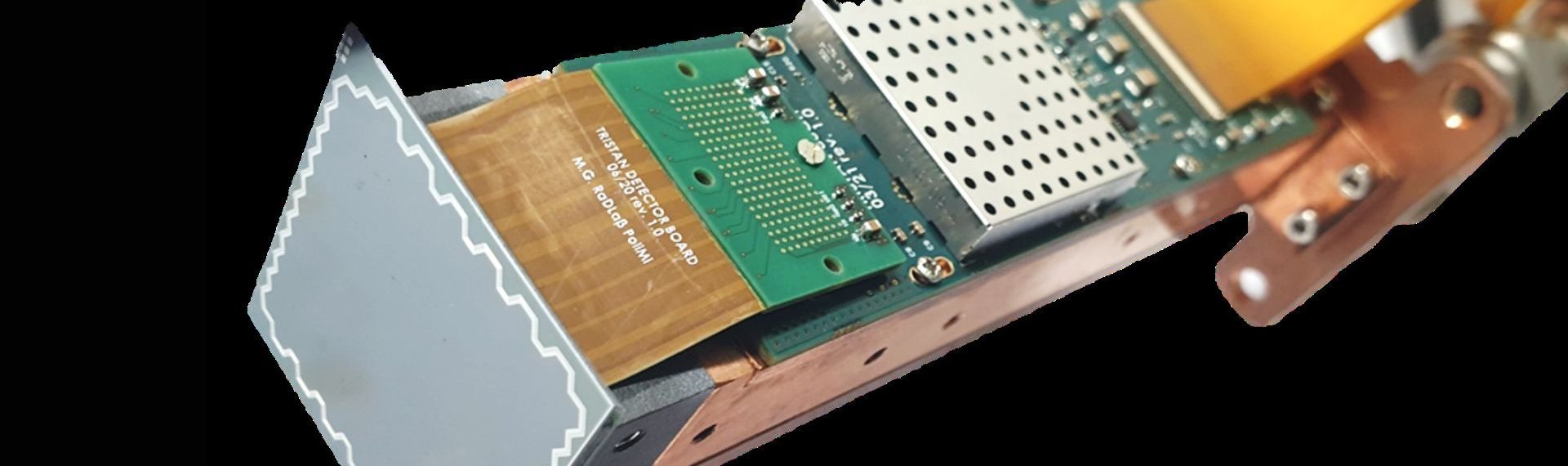
The KATRIN project (KArlsruhe TRItium Neutrino Experiment), led by KIT–Karlsruhe Institute of Technology in Germany and involving 20 institutions from seven different countries, including the Politecnico di Milano, celebrated the achievement of 1,000 days of neutrino measurements with the inauguration of phase 2 of the project: the commissioning of a new and more sophisticated detector, TRISTAN.
The RadLab research group of the Department of Electronics, Information and Bioengineering, led by Carlo Fiorini and Marco Carminati (the latter being the national coordinator for the experiment), also supported by the National Institute for Nuclear Physics, made a significant contribution to the creation of the new detector by designing and developing the detection modules and the low-noise, highly compact readout electronics of the SDD detector.
The adoption of the new detector will allow KATRIN to address a second scientific challenge, namely the search for a hypothetical fourth type of neutrino, known as “sterile”, as it is even more elusive than the other three. The TRISTAN detector upgrade will in fact make it possible to explore a broader parameter space compared to what is currently achievable, as demonstrated by the publication of the project’s first results in the journal Nature.
In this way, it will be possible to search for traces of this hypothetical particle within a range of values (mass on the order of keV, i.e. one thousand electronvolts, and mixing angle of one part per million) that would make it a promising candidate for explaining dark matter. Precisely identifying the neutrino mass, and finding the sterile neutrino, would be two fundamental objectives confirming that the current description of matter and standard interaction forces between particles is incomplete.